
Beginner's Guide
From your first 3×3 board to Ascension, Magic, and the Citadel
MergeCiv starts on a 3×3 grid with a single Wheat Field and unfolds into a multi-layer civilization strategy game. This guide covers every core system in the order you unlock it, with late-game layers tucked behind spoiler blocks until you want them.
Tile Merging Basics
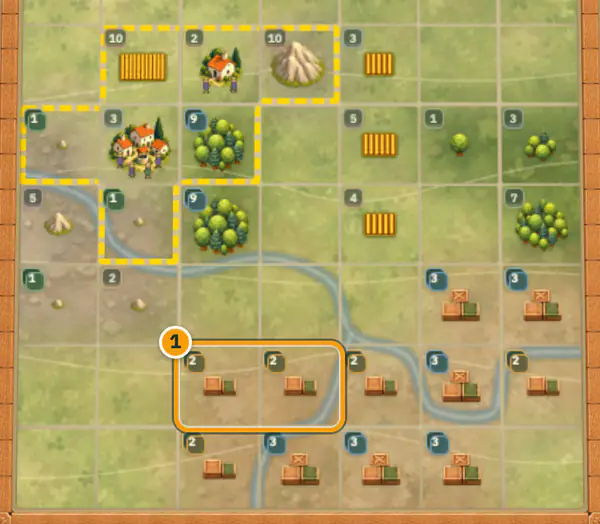
Merging is the heart of MergeCiv. Your grid starts as a 3x3 board filled with basic tiles. Drag one tile onto an identical tile of the same type and tier to combine them into a single higher-tier version. Resource tiles only produce while a settlement tile works them — tap or hover any Villager, House, Village, or Castle to see the dashed gold halo marking the cells it works.
Tile Types
- Wheat Fields — Generate Food, your foundational resource. Food feeds your workforce (+1/s upkeep per population point) and pays for new Villagers and early upgrades.
- Forests — Produce Wood, essential for spawning Stockpiles, unlocking settlement tiers, and expanding your grid.
- Ore Deposits — Yield Ore, a denser resource needed for mid-game upgrades, the Mage Tower, and eventually the Citadel.
- Workshops — Worked Workshops shift the Scout's discovery odds toward Stockpiles (+2% Stockpile weight per tier) and power the Workshop Assembly Lines upgrade.
- Stockpiles — Raise your Food, Wood, and Ore storage caps (+100 base capacity per tier, or +150 with Stockier Stockpiles maxed, multiplied by a 1.1x-per-tier bonus) without needing a Villager to work them.
- Villagers, Houses, Villages & Castles — Your settlement line. A Villager (Tier 1, 1 pop) works the cell to its right at 1x; a House (Tier 2, 2 pop) works right and left at 1.5x; a Village (Tier 3, 4 pop) works all 4 orthogonal neighbors at 2x; a Castle (Tier 4, 8 pop) works all 8 surrounding cells at 4x.
Essential Merging Rules
- Merge Villagers before spawning more. Every point of population doubles the Food cost of the next Villager and adds +1/s Food upkeep. Merging two Villagers into a House keeps your population and upkeep identical while freeing a cell and raising work output.
- Don't blindly merge two worked resource tiles. Resource tiles produce
tier × 1.1^(tier−1)/s before multipliers. Merging two worked Tier 1 tiles into one worked Tier 2 raises output (2.0/s → 2.2/s), but merging two worked tiles of Tier 2+ trades two streams for one ~1.65x stream — a ~17% production drop. Merge unworked tiles first, or drag an unworked tile onto a worked one. See the merge strategy guide for the full math. - Keep a merge buffer. A completely full board with no matching pairs locks your grid until you unlock Magical Upheaval.
- Merge Stockpiles aggressively. Higher-tier Stockpiles hold exponentially more resources while taking only one cell.
Resources and Economy
Your economy starts with three raw materials on the board, expands into Gold, Culture, and Mana after your first Resettlement, and unlocks deeper currencies in late-game layers.
Food
Generated by worked Wheat Fields. Spent on spawning Villagers (after meeting your +1/s per population upkeep) and early upgrades.
Wood
Produced by worked Forests. Spent on Stockpiles, settlement tier unlocks, and grid expansions. Keep Wood flowing so storage never bottlenecks your run.
Ore
Mined from worked Ore Deposits. Starts with a smaller base cap (60) and fuels mid-game upgrades, Apprentice improvements, and the Mage Tower.
Gold
Earned passively from Tribute (each past society recorded by Resettlement pays 0.001 × highest_tile_tier³ Gold/s) and Taxes (Gold/s per population). Spent on Imperial upgrades, the Magic Book, spells, and Artifacts.
Culture
Awarded when you Resettle based on your total settlement population. Spent in the Empire panel on permanent Legacy upgrades that survive Resettlements.
Mana
Unlocked by buying the Magic Book after your first Resettlement. Generated by the Apprentice while resting (and while working once you pass the MANA Test). Fuels spells, Magic upgrades, and Crystal infusions.
Storage Matters
Every resource has a capacity cap. When a bar fills up, excess production is lost. Build and merge Stockpiles early, and unlock Subterranean Stockpiles once you have Castles to move all storage onto a dedicated Underground grid.
Spoiler: Late-Game & Campaign Currencies (Knowledge, Metal & Valor)
- Knowledge — Generated by the Citadel center tile at its tier squared per second (1/s at Tier 1, 100/s at Tier 10). Libraries do not generate Knowledge; they raise your Knowledge storage cap (+10,000 per Library tier). Fuels Tier 5 research.
- Valor — Earned by your regiments fighting on The March after you unlock Conquest (Goblin Nuisance). Persists across Resettlements and Ascensions; spent on recruiting units, stat training, and unlocking Smelting.
- Metal — Unlocked via Smelting (Conquest landmark 10 + Department of Magical Appraisals + 2,500 Valor). Produced when a settlement works a Workshop adjacent to 1–2 Ore Deposits, scaling with the tier and yield of each connected Ore Deposit.
Upgrades
Upgrades are grouped by tier and currency in the Research panel. Knowing which upgrades survive resets helps you plan each run.
Standard & Scalable Upgrades (Tier 1)
Bought with Food, Wood, and Ore. Standard upgrades unlock tile types (Forest, Ore Mine, Villager, Stockpile), settlement merges (Houses, Village, Castle), automation (Auto-Scout, Apprentice), grid expansions (up to 6x6), and Resettlement. Scalable upgrades (Stockier Stockpiles, Stacked Stockpiles) stack across levels within a run.
Gold / Imperial Upgrades (Tier 2)
Purchased with Gold (plus raw resources) after your first Resettlement. Includes Taxes (passive Gold/s per population), Secure Vaults (+50 Gold cap per Stockpile tier per level), Grain Silos (+100% Food cap per level), and Scout/Apprentice speed upgrades.
Magic Upgrades (Tiers 3 & 4)
Opened after Resettlement via the Magic Book (1,000 Gold per level, up to Lv 100). Tier 3 unlocks Charge Up, MANA Test, Magical Upheaval, Infused Harvest, and the Mage Tower (10 levels of 50k Ore + 100 Mana to unlock Ascension). Tier 4 upgrades — including Mana Syphon, Fission, Conservation of Magic, Mana Monolith, and Reinvestment — persist through Resettlements and Ascensions.
Legacy Upgrades (Empire Panel)
Bought with Culture in the Empire panel and kept across all Resettlements in the current Ascension. Fellow Pilgrims starts every run with a settlement on the board, Traditions provide flat passive Food/Wood/Ore per second, Divine Mandate & Chief's Order keep Auto-Scout and the Apprentice unlocked, and Cultural Renown boosts Resettlement Culture by +50% per level.
Prestige and Ascension
Resettlement (Prestige) is MergeCiv's first reset layer. When your board fills up and the next Villager or upgrade takes too long, you Resettle to claim Culture and boost your permanent Gold income.
When to Resettle (and the Final Merge Push)
Resettlement unlocks once your grid reaches 6x6 and costs 5,000 Food, Wood, and Ore. Your Culture payout scales with total settlement population (multiplied by Cultural Renown, Ritual of Culture, and Roost Culture upgrades). Before clicking Resettle, always merge your highest-tier tiles one last time — even Stockpiles or unworked tiles — because each Resettlement records a past society whose permanent Tribute Gold/s scales with the cube of the highest tile tier on the board when you resettle (0.001 × tier³/s).
Ascension
Building the Mage Tower to level 10 unlocks Ascension, the second reset layer. Ascending resets your board, Gold, and Culture upgrades, but claims all pending Magic Crystals you charged with Mana during the run. Each owned Magic Crystal permanently adds +100 Mana capacity and can be assigned to Rituals (such as a 7x7 grid, starting with a maxed Magic Book, 10x–1,000x storage caps, or keeping automation across Ascensions).
Magic System
Magic begins after your first Resettlement, well before Ascension. Initially, clicking Rest pauses the Apprentice's merging so it can channel Mana; passing the MANA Test (5,000 Gold + 100 Mana) removes the Rest button so your Apprentice generates Mana continuously while working.
Spells
- Magical Upheaval (100 Mana) — Destroy any tile on the Surface or Underground grid. Essential for clearing low-tier clutter or breaking a deadlocked board.
- Infused Harvest (100 Mana) — Instantly harvest a burst of resources from a resource tile, scaling with its tier and your Infused Jerky artifact.
- Fission (2,000 Mana) — Split one tile of Tier 2+ into two tiles of one tier lower (requires an empty cell). The two halves carry the exact merge value of the original tile — use it to create a merge partner or split one high-tier producer into two worked tiles.
Mana Capacity & Crystal Infusions
Your Mana cap equals your Magic Book level (up to 100), plus 100 per owned Magic Crystal, plus your appraised Glistening Gem bonus. Once the Mage Tower is complete, you can infuse Mana into pending Magic Crystals (or let Mana Syphon automatically funnel overflow Mana into crystals whenever your bar is full).
Artifacts
After your first Ascension, unlocking the Department of Magical Appraisals (100M Wood + 100M Ore) opens the Artifacts tab and automatically appraises every artifact you find. Artifacts are bought with Gold: the first purchase in an Ascension costs 1,000,000 Gold, each purchase multiplies the price by 1.3x, and Ascending resets the Gold price back to 1,000,000 while keeping every artifact and level you own.
Notable Artifacts
- Golem (Rare) — Multiplies Food, Wood, and Ore production by 1.2x per level.
- Itemized Paystub (Rare, guaranteed first Rare) — Adds +1 Gold/s per population per level, supercharging Taxes.
- Interest Accumulator (Epic, guaranteed first Epic) — Generates passive Gold/s equal to 1% of your current banked Gold per minute per level (capped at 50%/min).
- Printing Press (Legendary, guaranteed first Legendary) — Generates passive Culture/s equal to 1% of your current Resettlement reward per minute per level.
Spoiler: Artifact Drop Odds, Guarantees & Imbuement
Your first Rare pull is always Itemized Paystub, your first Epic is always Interest Accumulator, and your first Legendary is always Printing Press; unowned Epics and Legendaries are always prioritized before duplicates. Duplicate pulls grant 1 XP toward the artifact's next level along a Fibonacci curve (1, 3, 5, 8, 13, 21...).
Later, purchasing the Artifact Phylactery (100M Culture) lets you Imbue a level 10+ artifact at the Citadel: it consumes the Phylactery and performs a full Citadel-tier reset to rebirth that artifact at level 1 one rarity higher (up to Mythic with the Astral Tree's Reliquary constellation) with amplified scaling and fewer marbles in the drop bag. See the Ascension & Magic guide for full details.
Grid Layers & Beyond
As your civilization expands, you unlock additional grid layers and long-term progression modes beyond the starting board.
Surface
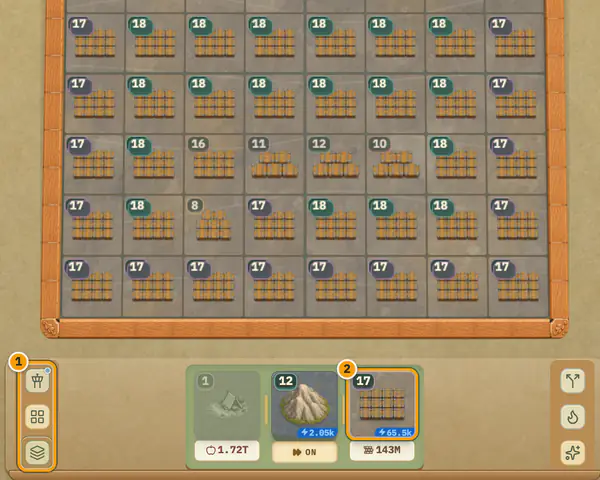
Your main gameplay board. Starts at 3x3, expands to 6x6 via Standard upgrades, and reaches 7x7 and 8x8 through Ritual of Space and Border Expansion.
Underground
Unlocked via Subterranean Stockpiles (500k Wood + 500k Ore, requires Castles). Moves all Stockpiles to a dedicated subterranean grid that mirrors your Surface dimensions so your Surface board stays free for settlements and producers.
Spoiler: Late-Game Layers & Modes (Citadel, Conquest, Aerie, Roost & Transcension)
- The Citadel — Unlocked via Plans for Citadel (1M Culture) and built across 10 levels of Build Citadel (100M Ore each + 10k to 100k Mana). Opens a 3x3 grid (expandable to 5x5) where the center tile generates Knowledge (
tier²/s), Libraries raise Knowledge cap, Theatres raise Culture cap, and completed Citadels can be Imbued up to Tier 100 to unlock permanent Milestones. - Conquest (Muster Grounds & The March) — Unlocked by Goblin Nuisance (100k Food). Recruit and merge regiments on the Muster Grounds, click any unit tile to train its stats or unlock class branches, and march down a 300-landmark road to earn Valor, Smelting, and Star Pieces.
- The Roost & The Aerie — Reaching Citadel Tier 3 unlocks The Roost, where birds perch on your boards and drop Feathers for permanent multipliers. Buying the Dragon Egg (1,000 Gold) opens The Aerie & Wyrmfall, whose Dragon Hoard raises maximum Gold capacity by up to 50% and multiplies Empire Tribute by up to 10x.
- Transcension & The Astral Tree — At Citadel Tier 100 (with Build Citadel level 10), you can Transcend, banking 1 Star Piece per 100 Conquest landmarks cleared and unlocking the permanent Astral Tree and Tier II unit specializations.
Automation & Idle Play
Automation upgrades handle routine spawning and merging while you focus on layout, upgrades, and reset timing.
The Apprentice (Auto-Merge)
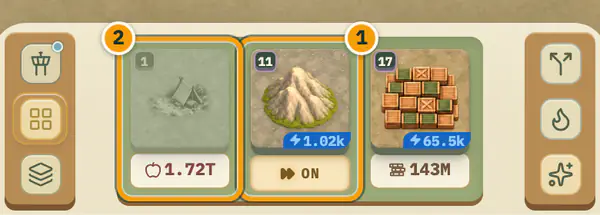
Unlocked via Apprentice (1,000 Food + 200 Ore). Smart Apprentice protects tiles currently worked by a settlement, Genius Apprentice lifts that restriction when you want worked tiles merged, Space Conscious Apprentice leaves Stockpiles alone until the grid is full, and Apprentice Control lets you toggle [Work] on individual tiles to pin them in place.
The Scout (Auto-Spawn)
Hand-spawning recharges in 3 seconds, and Auto-Scout (500 Food + 500 Wood) delivers a new tile every 10 seconds (halved per level of Animal Husbandry). The Scout strongly prefers empty cells beside tiles of the same type and tier, naturally forming merge clusters.
Offline Earnings & Speed Boosts
While closed, your civilization accrues up to 12 hours of production (capped by your storage limits) and banks up to 4 hours of 10x Speed Boost time. See the Idle Progression guide for the full math and daily boost routine.
The MergeCiv Handbook
Each chapter below dives deep into one system with exact formulas and worked examples from the game's code:
- Merge Strategy: When to Merge and When to Hold — worked-tile math, settlement halos, and Scout zoning.
- Resource Guide: Every Resource and How to Earn It — all currencies, tile chains, and stage bottlenecks.
- Resettlement & Culture Guide + Resettlement Culture Calculator — timing resets, Tribute Gold, and Legacy buy order.
- Ascension, Magic, Artifacts & Rituals — Mana, spells, Crystal charging, Artifacts, and the 9 Resonance Rituals.
- Underground & Citadel Guide — Subterranean Stockpiles, Knowledge, Libraries, Theatres, and Citadel Imbuement.
- Conquest Guide: The Metal War — the Muster Grounds, the 300-landmark Road, Valor, Smelting/Forges, and Class Identities.
- Idle Progression & Boosts — 12-hour offline math, 10x Speed Boosts, and the two-session daily routine.
Quick Reference & Comparisons: Strategy Tips · FAQ · Merge Games Without Energy · MergeCiv vs Merge Mansion · Browser Idle Merge Games