
Resettlement and Culture: The Complete MergeCiv Prestige Guide
Resettlement is where MergeCiv stops being a farm and starts being a strategy game. Your first reset feels like starting over; by your fifth, every run is a deliberate Culture harvest. This guide covers when to pull the trigger, what you keep, how the Culture math works, and what to buy after each reset. Still pre-prestige? Start with the Beginner's Guide.
Unlocking Resettlement
Resettlement is a Standard upgrade costing 5,000 Food, 5,000 Wood, and 5,000 Ore, and it requires the 6x6 grid expansion (Claim Surrounding Land) first. Buying it opens the Empire panel, where a button reads "Resettle for X Culture" — the X is exactly what cashing out is worth, and it grows with your civilization.
Do not press it the moment it lights up. The entire economy of prestige is built around the fact that Culture scales superlinearly with population. A run that ends too early is a run that mostly wasted its setup time.
What Resets, What Persists
Know this list before your first reset, because it dictates what is worth investing in late in a run.
Resets
- Your Surface and Underground grids, back to 3x3 (plus any Ritual of Space and Border Expansion bonuses).
- Food, Wood, Ore, Gold, Mana, and Metal balances.
- Tier 1–3 Standard and Scalable upgrades (such as grid expansions, settlement unlocks, Magic Book, and Mage Tower levels).
Persists
- Culture Points and every Legacy upgrade you have bought with them.
- Gold upgrades — Taxes, Grain Silos, Secure Vaults, Mounted Scouting, Workshop Assembly Lines, Subterranean Stockpiles, and spell unlocks survive even though your Gold balance resets.
- Tier 4 upgrades (Reinvestment, Mana Monolith, Mana Syphon, Fission, Conservation of Magic, Capacitative Efficiency, Department of Magical Appraisals, Build Citadel) and all Tier 5 Knowledge research.
- Knowledge, past societies (Tribute), artifacts, Magic Crystals, Conquest progress (Valor, road landmarks, and Muster Grounds army), The Roost, and the Citadel grid.
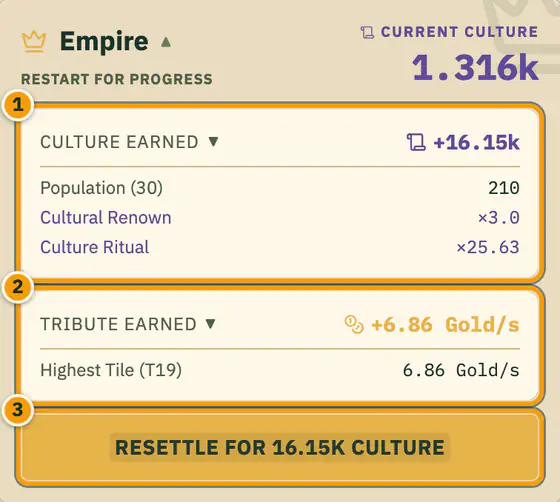
The sleeper mechanic here is Tribute. Every Resettlement records a "past society" that generates passive Gold forever, equal to 0.001 × (your highest tile tier at reset)³ per second. Cubic scaling means one more merge on your best tile before resetting is a permanent raise: a tier 8 tile pays roughly 49% more Tribute than a tier 7. Always squeeze that last merge in before you push the button.
How Culture Points Actually Scale
Base Culture on a Resettlement is max(2×P, P + P²/5), rounded down, where P is your Villager population. Population is the sum of 2^(tier−1) across the settlement chain: a Tier 1 Villager counts 1, a House 2, a Village 4, a Castle 8.
The max() matters early: at very low population the flat 2-per-pop side wins, which is why tiny runs feel underwhelming. Past five population, the quadratic term takes over and every additional point pays more than the last.
Worked Example
End a run at population 10 and you bank max(20, 10 + 100/5) = 30 Culture. Grind that same run to population 20 — twice the people — and you get max(40, 20 + 400/5) = 100 Culture, more than triple. Push to 30 and it is 210. Doubling your patience roughly triples your payout.
Growing P is the real game, and it isn't free. Each new Villager costs 100 × 2^population Food — the price doubles with every population point — and every point of population eats 1 Food per second. Merging up the chain (two Villagers into a House, and so on) doesn't change your population total, but it frees grid space and higher tiers work more land: a Castle works all 8 neighbors at a flat 4× yield, which is what funds the food bill in the first place. For when to merge settlements versus letting them keep working, see the Merge Strategy guide.
Multipliers stack on the base (applied in order with each step rounded down): Cultural Renown adds +50% per level across four levels (up to 3x), Ritual of Culture multiplies by 1.5 per level, the Historic Compendium artifact multiplies by 1.2 per level (or 1.3–1.5x when imbued), the Accelerating Timepiece artifact grows with hours played this run, Mentor Bonds add +5% to +10%, and The Roost's Culture Feathers add +5% per level (up to +50%).
To run these numbers for your own board, use the Resettlement Culture Calculator: enter your settlement tiles and multiplier levels to see what Resettling pays right now and what each of the next few Villagers would add and cost.
Timing Your First Resettlement
Aim to make your first reset fund the core early Legacy kit: Fellow Pilgrims (3 Culture), Craftsmanship (5), Animal Husbandry (10), Chief's Order (15), and Divine Mandate (25). That is 58 Culture total, which means roughly population 15 (60 Culture base). Resetting at population 8 instead yields only 20 Culture — not even half the kit for most of the same setup work.
Practically, that first run means unlocking Houses (1,000 Wood + 500 Ore) and Village (2,500 Wood + 250 Ore) to compress your Villagers, because raw spawning gets expensive fast. Don't sweat the Castle on run one — at 100,000 Food + 20,000 Ore it is a goal for later loops. And before resetting, merge your highest-tier tile one last time to lock in higher permanent Tribute.
Legacy Upgrade Priorities After Each Reset
Legacy upgrades are bought with Culture and persist across Resettlements in your current Ascension. Recommended buy order:
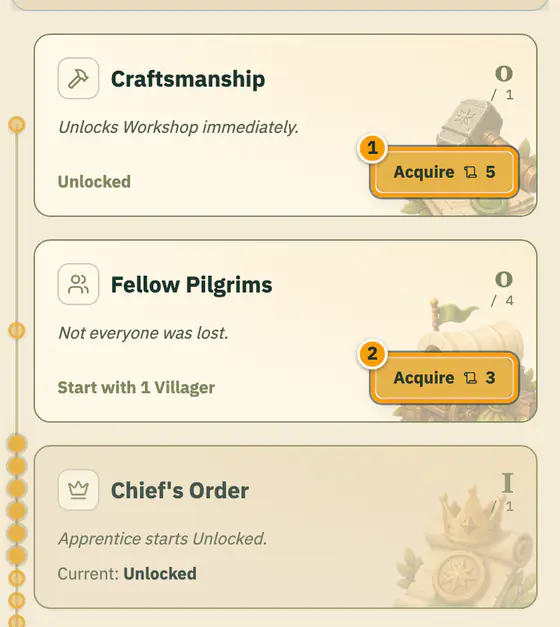
- Fellow Pilgrims (3/10/25/50) — starting Villagers mean your fresh 3x3 produces from the first second.
- Craftsmanship (5) — unlocks the Workshop; worked Workshops make the Scout bring Stockpiles, fixing early storage.
- Animal Husbandry (10/25/50) — halves the Auto-Scout interval per level. Compounds with everything.
- Chief's Order (15) — the Apprentice starts unlocked, skipping its 1,000 Food + 200 Ore cost every single run.
- Divine Mandate (25) — Auto-Scout from the first second. Paired with Chief's Order, your run automates itself immediately.
- Cultural Renown (10/30/60/100) — +50% Culture per level. Buy levels as soon as they're affordable; they pay for themselves within a reset or two.
- Traditions (Agricultural/Forestry/Mining, 5/50/500/5000) — passive +1/+10/+100/+1000 per second income that flows even with no tiles worked. The cheap tiers are great; the expensive tiers can wait.
Honorable mention: Reinforced Stockpiles (10–200) raises the compounding per-tier bonus on every tile by 5% a level, which quietly lifts both production and storage all run.
Spoiler: Late-Game Legacy Goals (Border Expansion, Citadel & Phylactery)
- Plans for Mage Tower (200 Culture): Unlocks the Mage Tower upgrade in your Research list, opening the road to Ascension.
- Border Expansion (10,000 Culture): Adds +1 grid width/height, pushing a 7x7 board (with Ritual of Space) to the maximum 8x8 Surface and Underground grid.
- Plans for Citadel (1,000,000 Culture): Unlocks the Citadel build chain. Because the base Culture cap is 1,000,000, you must fill your Culture bar completely (or earn passive Culture via the Printing Press artifact) before purchasing it.
- Resonant Crystals (1M / 10M / 100M Culture) & Artifact Phylactery (100M Culture): Unlocked after building the Citadel and Theatres to expand your Culture cap above 1M; Resonant Crystals multiplies all resource production by 2x per level, and the Artifact Phylactery unlocks Artifact Imbuement at the Citadel.
Pacing Across Multiple Resettlements
Loops two through five are about velocity. Each reset starts faster than the last thanks to your Legacy kit, and your stacked past societies pay growing Tribute — which funds Gold upgrades like Taxes (+1 Gold/sec per population per level) and Grain Silos, all of which survive every Resettlement. Automate early, compress Villagers upward, and reset when the "Resettle for X Culture" payout slows down relative to a fresh run.
The pivot comes at 200 Culture: Plans for Mage Tower opens the road to Mana, spells, and the game's second reset layer. Once you are consistently banking triple-digit Culture per loop, start saving for it and read Chapter 5: Ascension & Magic before you commit. Until then, finish Cultural Renown — all four levels triple your Culture income.
Keep Reading
Next in the Handbook: Chapter 5: Ascension & Magic · Chapter 6: Underground & Citadel · Chapter 7: Conquest & The Forge
Play MergeCiv · Beginner's Guide · Culture Calculator · Tips & Tricks · FAQ