
Underground and Citadel: Mastering MergeCiv’s Hidden Layers
By defsnotb · Updated October 2026
Beyond the Surface grid lie two additional boards: the Underground, a dedicated Stockpile annex that frees your Surface cells for production, and the Citadel, a permanent board whose center tile generates Knowledge across every reset in the game. This chapter covers how to unlock both, how Knowledge research and Theatres work, and how Citadel Imbue and Transcension reshape the endgame.
Three Layers, Three Timescales
The Surface is where core resources are produced. Wheat Fields, Forests and Ore Deposits only yield when a settlement works them from an adjacent cell — if that is new to you, start with the Beginner's Guide. The Surface runs on a timescale of minutes: merges, Scout spawns, and Resettlement cycles.
The Underground runs on a timescale of hours. It holds Stockpiles and nothing else, freeing your Surface grid for settlements and worked producers.
The Citadel runs on a timescale of days and weeks. Its center tile generates Knowledge continuously, and the upgrades you buy with Knowledge survive every reset.
The Underground Is a Surface Buff in Disguise
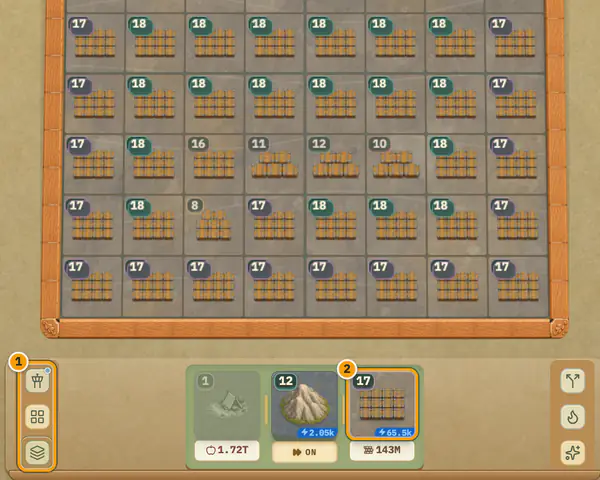
Subterranean Stockpiles costs 500,000 Wood and 500,000 Ore and requires the Castle unlock first (the 100,000 Food, 20,000 Ore upgrade at the top of the settlement chain). Once researched, your Stockpiles move to a dedicated layer below the Surface, toggled with Go Underground and Back to Surface. Every Stockpile moved underground frees a Surface cell around your Castles (which work all eight neighbors at a flat 4x yield).
Storage still governs your offline and active ceilings: production that overflows a full cap is lost, so a deep bench of merged, high-tier Stockpiles is essential before long offline stretches. Keep merging down there: capacity scales with Stockpile tier, while build costs climb with every Stockpile you currently own — starting from a 50 Wood base (trimmed by the Wooden Box artifact).
The Million-Culture Wall
The Citadel starts in the Legacy tab. Plans for Citadel costs 1,000,000 Culture — the entire default Culture cap before you own a Theatre. Because Culture comes from Resettlement payouts that scale quadratically with population, reaching a million is a string of high-population resets (or passive Culture from a Legendary Printing Press artifact). See Chapter 4: Resettlement & Culture for the multiplier stack.
Plans unlocks Build Citadel: ten construction levels, each costing 100 million Ore plus Mana that escalates from 10,000 at level 1 to 100,000 at level 10 (1 billion Ore and 550,000 Mana total). Because Build Citadel is a Tier 4 upgrade, partially completed levels survive Resettlement and Ascension, and Mana Monolith levels survive Ascension to help fund the Mana bill (see Chapter 5: Ascension & Magic). Finishing level 10 opens a 3x3 Citadel grid centered on the Citadel tile itself.
Knowledge: The Currency That Never Dies
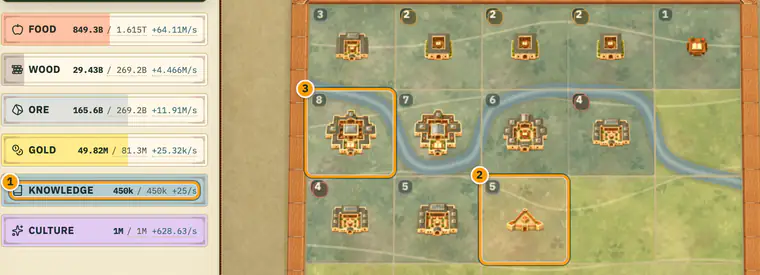
The Citadel center generates Knowledge equal to its tier squared (tier²) per second. At tier 1 that is 1 per second — and Knowledge persists through Resettlement, Ascension, and Citadel Imbue.
Tier 5 research is priced in Knowledge: Residential Planning (100,000 per level) to spawn Houses, Villages and Castles directly; Fiction (10,000 per level); The Evening Paper (400,000 Knowledge, enabling tick-by-tick offline interest compounding); Coalesce Knowledge (370,000 Knowledge, expanding the Citadel grid from 3x3 to 5x5); and Detect Magic (300 Knowledge, ×10 per level, max 6, which awakens unappraised artifacts found without the Department of Magical Appraisals). To bank sums like that you need Libraries — the first costs 10,000 Knowledge and every Library you already own adds another 10,000 to the next one's price (trimmed by 200 per level of the Boundless Book artifact). Libraries raise your Knowledge capacity (+10,000 per tier), so build and merge them before saving for large T5 upgrades.
Worked Example: Pricing Coalesce Knowledge
At Citadel tier 1 the center makes 1 Knowledge per second, so Coalesce Knowledge's 370,000 price is roughly 103 hours of generation. After two Imbues, at tier 3, the center makes 9 per second and the same purchase takes about 11.4 hours. Squared scaling means each Imbue collapses your research timelines.
Fiction, Theatres, and Raising the Culture Ceiling
Fiction makes Libraries generate passive Culture: 1 per Fiction level, per Library tier, per hour. Its primary role is unlocking the Theatre.
Theatres cost 1,000,000 Knowledge plus Culture that scales with the Theatres already standing — 1,000,000 for the first, 2,000,000 for the second, and so on. Each Theatre tier raises your Culture capacity by 1,000,000. Merging two rank 1s into a rank 2 (+2M cap) loses zero capacity and lowers the next Theatre's purchase price, whereas merging two rank 2s (+4M cap) into one rank 3 (+3M cap) trades 1M of capacity for grid space. Raising your Culture cap above 1M lets a single Resettlement fund Plans for Citadel with Culture to spare, and unlocks multi-million Culture upgrades: Conquest class identities (2M / 10M), Cultural Advancement (1M Knowledge + 20M Culture, auto-buying Culture upgrades), Resonant Crystals (1M / 10M / 100M Culture), and the Artifact Phylactery (100M Culture).
Critical Citadel Grid Rule: Unlike the Surface, the Citadel layer has no Magical Upheaval spell and cannot merge-on-drop directly from the purchase buttons when every cell is full. Always keep at least one empty cell or one mergeable pair of Libraries/Theatres on the Citadel grid before buying a new Tier 1 building so you never deadlock your slots before researching Coalesce Knowledge (5x5 grid).
Citadel Imbue: The Rebirth
Once Build Citadel reaches level 10 and your Knowledge and Culture bars are full, clicking the Citadel center tile reveals IMBUE CITADEL — raising the Citadel's permanent tier by one (up to tier 100), multiplying Knowledge generation as tier²/s, and resetting the lower layers for a new cycle.
Spoiler: What Citadel Imbue Resets, Keeps & Unlocks (Milestones, Phylactery, Roost & Transcension)
What Imbue Resets — and What It Keeps
- Reset: Culture Points, Magic Crystals and their ritual assignments, past societies (your Tribute income), Legacy upgrades, T1–T4 upgrades including Build Citadel itself, the Surface and Underground grids, resources, and Mana.
- Kept: T5 research, artifacts, your Knowledge balance, Valor and Conquest progress, The Roost, Astral Tree constellations, and the Libraries and Theatres standing on the Citadel grid.
Milestones & The Roost: Imbue consumes your Magic Crystals (unless you later unlock Crystal Echo in the Astral Tree) and resets Build Citadel, but each cycle climbs faster thanks to your standing Libraries, Theatres, and Citadel Milestones (awarded at tiers 1–10 and every 5 tiers up to 100, granting permanent Knowledge/Culture capacity, Crystal multipliers, and auto-buyers). Reaching Citadel Tier 3 unlocks The Roost, where birds perch on your boards and drop Feathers for permanent multipliers.
Artifact Imbuement vs. Citadel Imbue: Purchasing the Artifact Phylactery (100M Culture) lets you Imbue a level 10+ artifact at the Citadel. Doing so consumes the Phylactery and triggers the exact same full Citadel reset as a regular Citadel Imbue, promoting that artifact one rarity higher (reborn at level 1) instead of adding +1 Citadel tier.
Transcension (Citadel Tier 100): Reaching Citadel Tier 100 (with Build Citadel level 10) unlocks Transcension, which banks 1 Star Piece per 100 Conquest landmarks cleared, resets the Citadel, artifacts, and Conquest campaign, and opens the permanent Astral Tree.
Splitting Your Attention
Treat each layer according to its timescale. The Surface gets your active minutes — merges, settlement placement, and Resettlement timing. The Underground gets a visit when Wood is overflowing or right before a long offline stretch: add a Stockpile, merge what is there, and return to the Surface. The Citadel gets one glance per session: check your Knowledge bank against your next T5 target or Library/Theatre milestone and let it tick.
Keep Reading
Next in the Handbook: Chapter 7: Conquest & The Forge · Chapter 8: Offline & Boost Math
Play MergeCiv · Beginner's Guide · Ascension & Magic · Tips & Tricks · FAQ