
Conquest Guide: The Metal War
Conquest ("The Metal War") is a permanent campaign beside the merge board, with an army you build by merging on the Muster Grounds, a 300-landmark road, a Forge that refines Ore into Metal, and class specializations that culminate in the Astral Tree.
Unlocking the War
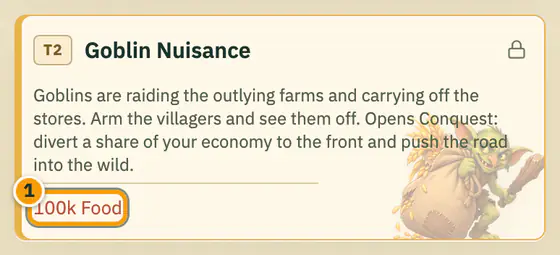
Conquest opens through a Research card called Goblin Nuisance: 100,000 Food, Villagers unlocked, never bought by autobuy. It adds a War tab with two views, the Muster Grounds and The March. Resettlement, Ascension, and Citadel Imbue replace your settlement, not your campaign — so the road, your standing army, every war Research card, and your Valor carry across all three resets. Metal is a settlement resource and resets with the run (until you unlock Celestial Steel III in the Astral Tree).
The Muster Grounds
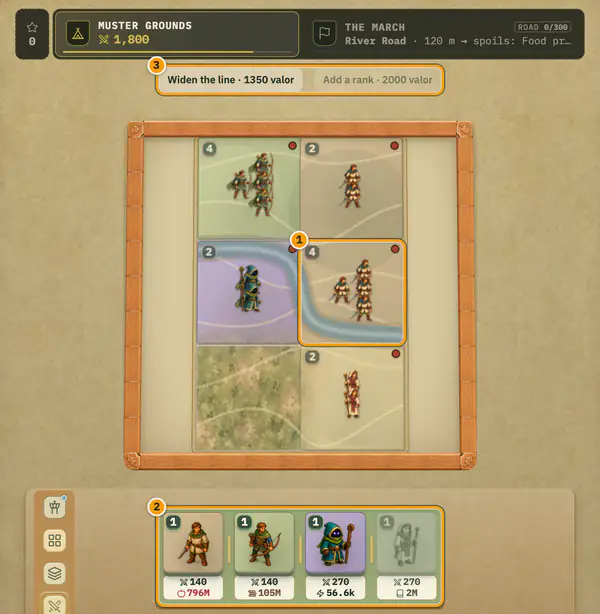
Your army is a merge board. Each tile is a regiment of one unit line and merges like any other tile: same line, same tier, one tile a tier higher. A tile's tier is its population: a Tier 2 Militia tile fields two militia. Merging two Tier 1 tiles is population-neutral (1 + 1 = 2), while merging Tier 2+ trades soldiers for board space (two Tier 3 tiles hold six soldiers; one Tier 4 holds four) in exchange for per-tier combat stat scaling.
The grid is your formation: each row of the camp is a line of battle, drawn with forward to the right, so the vanguard is the right-hand column. The board starts at 2x1 and grows up to 8x4; Widen the line and Add a rank are bought with Valor, and width is deliberately cheaper.
Recruiting, Merging & Resource Icons
The dock carries Tier 1 recruits: drop one on open ground to recruit there, or onto a matching Tier 1 tile to recruit and merge at once. Always merge Tier 1 regiments into Tier 2s first (zero soldier loss); only merge Tier 2+ when your Muster board is full.
Each recruit costs Valor plus its line's dedicated settlement resource (and Metal for armored/magical lines):
- Militia — Food (wheat icon; opens at 0 Valor for the first tent, never costs Metal)
- Archers — Wood (log icon; opens at 0 Valor for the first tent, never costs Metal)
- Spearmen — Ore (pickaxe icon) + Metal
- Mages — Mana (orb icon) + Metal (once Smelting is unlocked)
- Priests — Knowledge (book icon — Knowledge from the Citadel, not Culture!) + Metal (once Smelting is unlocked)
- Horsemen — Gold (coin icon) + Metal
How Recruit Prices Scale: A line's Valor and settlement-resource recruit prices scale with the soldiers currently standing on the Muster Grounds, whereas its Metal recruit price tracks the highest headcount that line has ever fielded. Consequently, merging Tier 2+ tiles or dismissing a unit with the Writ of Dismissal (1,000 Valor) frees board space and lowers future Valor and settlement-resource recruit costs (while Metal costs stay tied to your all-time peak host).
The Six Lines
Militia are unlocked from the start. Every other line is a Research card requiring the one before it: Archery (750 Valor), War Sorcery for Mages (3,000 Valor), Holy Orders for Priests (9,000 Valor), The Spear Wall (15,000 Valor + 10,000 Metal) and The Stables for Horsemen (40,000 Valor + 50,000 Metal).
Militia deal 1 damage with 10 health and no armor. Archers shoot from long range and kite away from nearby enemies. Mages ignore 2 armor and splash an area. Priests heal nearby allies. Spearmen wear 2 armor; Horsemen wear 3, hit for 2, and close distance fastest. Each point of armor soaks 1 damage per blow, floored at 0.5 damage.
The Road and Its Landmarks
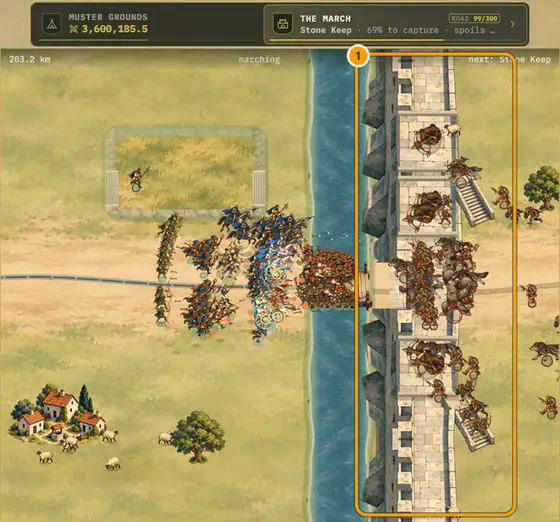
The Conquest Road is 300 stones long. Every stone is a holding held by goblins, hobgoblins, trolls or a warlord — Farmland, Lumber Camp, Ore Mine, Mana Well or Workshop — and every twenty-fifth is walled: Walled Towns and Stone Keeps alternate, and the High Keep closes the road at Landmark 300. Every captured holding grants a permanent compounding boost (+2% production for Food, Wood, Ore, or Mana; +3% for Metal; or storage capacity on select holdings). Each walled landmark raises every future Valor award by 25%, compounding (nearly 15x across all twelve walls).
Ground is only captured in live battle while The March is open. Walled sites are sieges — palisades with arbalest towers, then stone keeps with moats and mangonels — where impact damage hits walls hardest and slashing least. Use the Sound the Advance button to hold and release your waves so your entire formation charges a siege together instead of trickling in one by one.
Valor
Valor is earned one point per soldier who falls in battle, on either side (multiplied by captured walled landmarks). It buys recruits, Muster board expansions, unit training, and war Research cards. When you step away for more than a minute, your camp pays offline Valor at 10% of your army's best five minutes of live fighting ever recorded (for up to eight hours per absence), and Boost claims grant the same fraction.
Metal and the Forge
Smelting costs 2,500 Valor, unlocks once you clear Landmark 10 and own the Department of Magical Appraisals (100M Wood + 100M Ore), and persists across resets. A Forge is a Workshop on the Surface worked by a settlement and seated beside 1–2 Ore Deposits; it draws up to two streams from adjacent Ore Deposits and refines them into Metal (starting cap 50, extended by Stockpiles). Bellows (500 Metal, tripling per rank, 20 ranks) multiplies refine speed by 1.25x per rank; Stronger Alloys (3,000 Metal, quadrupling per rank, 6 ranks) adds +6% to Food, Wood and Ore gathering per rank.
Spoiler: Apprentice-Proof Forge Layouts (How to Maximize Metal/s)
Each Forge stream refines 0.01 Metal/s base and scales up with every order of magnitude of the connected Ore Deposit's own Ore/s yield (based on that mine's tier and tile-yield upgrades), while consuming 10 Ore per 1 Metal from your stockpile. However, any Ore Deposit connected to a Forge is committed to the furnace and stops producing normal Ore.
- Seat your highest-tier Ore Deposits beside worked Workshops: Higher-tier connected Ore Deposits drive each stream further up the logarithmic refine curve, while unconnected worked mines (or passive Ore traditions) keep your Ore stockpile supplied.
- Stagger the tiers of adjacent Ore Deposits: Place high-tier Ore Deposits of different tiers (e.g. Tier 11 and Tier 12) beside your Forges and turn Auto-Scout off. Because the flanking mines do not share a tier, the Apprentice can stay active merging Underground Stockpiles without ever collapsing your two Forge streams into one!
Training and Identity
How to open Unit Training: Click directly on any unit tile on the Muster Grounds (watch for the red dot notification) to open that line's Training & Identity sheet. Each line trains three or four core stats (such as health, damage, respawn speed, fire rate, range, armor, penetration, or healing) for Valor — plus Metal for armor ranks on Spearmen and Horsemen.
Spoiler: Class Specializations (Identities) & Transcension (Astral Tree)
Class Identities (2M for First Branch, 10M for Second Branch): Once a unit line reaches 6 total trained stat ranks, you can unlock its specialized Identity branches using Culture (requiring Theatres on the Citadel to raise your Culture cap above 1,000,000). Unlocking a line's first branch costs 2,000,000 Culture and unlocking its second branch costs 10,000,000 Culture (whichever branch you pick first). Switching between unlocked branches is free, though gearing up to a heavier-armored branch (such as Halberdier, Tower Shield, Battle Priest, or Knight) bills the Metal difference across your standing soldiers:
- Militia: Berserker or Swordsman
- Archers: Longbowman or Crossbowman
- Spearmen: Halberdier or Tower Shield
- Mages: Fire Mage or Ice Mage
- Priests: Medic or Battle Priest
- Horsemen: Light Cavalry or Knight
Transcension & The Astral Tree: Reaching Citadel Tier 100 (with Build Citadel level 10) unlocks Transcension, which awards 1 Star Piece for every 100 Conquest landmarks cleared, resets your Citadel, artifacts, and Conquest campaign, and opens the permanent Astral Tree — featuring Celestial Steel (passive Metal/s and Metal persistence across resets), Reliquary (Mythic artifact imbuement), Crystal Echo, and Tier II unit class specializations.
Key Conquest Takeaways
- Widen before you deepen. Columns are cheaper than ranks, and a wider vanguard lets more regiments engage at once.
- Merge Tier 1 → Tier 2 immediately, then hold. Two Tier 1 tiles merge into a 2-soldier Tier 2 tile with zero headcount loss; higher merges trade bodies for space.
- Keep The March on screen when pushing walls. Ground and peak Valor rates only advance in live battle — use Sound the Advance so your waves hit sieges together.
- Spend Metal before Resettling (until Celestial Steel III). Metal resets on Resettlement and Ascension unless you have unlocked the final rank of Celestial Steel in the Astral Tree.
Keep Reading
Next in the Handbook: Chapter 8: Offline & Boost Math · Chapter 6: Underground & Citadel
Play MergeCiv · Beginner's Guide · Resource Guide · Tips & Tricks · FAQ