
MergeCiv Resource Guide: Every Resource and How to Earn It
MergeCiv has six core resources (plus late-game campaign currencies) and one rule that governs everything you grow on the grid: nothing produces without a settlement working it. This is the full reference — every resource, what produces it, what it buys, and where each stage of the game bottlenecks.
Nothing Produces on Its Own
Resource tiles produce nothing unless a settlement works them. A Tier 6 Forest with no worker beside it is scenery. Coverage depends on the settlement's tier — a Tier 1 Villager works only the tile to its right (1x), a Tier 2 House adds the tile to its left (1.5x), a Tier 3 Village adds the tiles above and below for four in total (2x), and a Tier 4 Castle works all eight neighbors at a flat 4x yield. The Scout already knows this: its placement logic clusters resource tiles next to your settlements, so work with the clumps it builds instead of rearranging them.
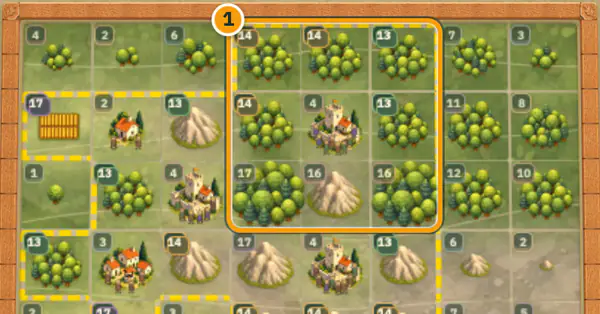
A worked tile's output is its tier per second, scaled up by a compounding tier bonus (1.1^(tier−1), raised by Reinforced Stockpiles) and by its strongest adjacent settlement (1x / 1.5x / 2x / 4x). Labor is not free, though. Every population point eats 1 Food per second, forever, and population doubles with each settlement tier: 1 for a Villager, 2 for a House, 4 for a Village, 8 for a Castle. The only income that skips all of this is passive: the Agricultural, Forestry and Mining Tradition legacies and a few artifacts pay out with no tiles at all. If any of this is new, start with the Beginner's Guide.
Six Core Resources (Plus Late-Game Currencies)
Food
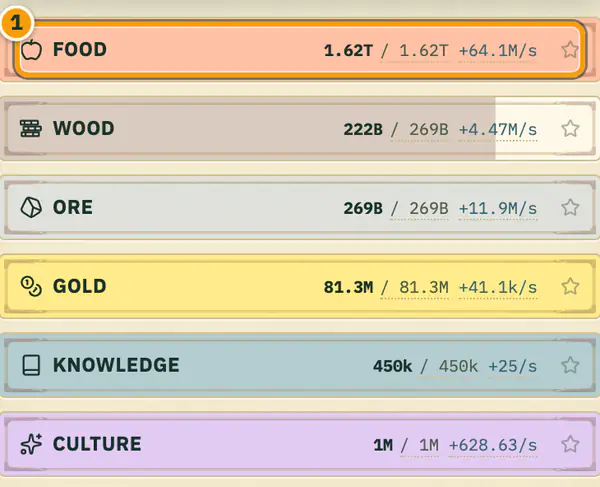
From worked Wheat Fields, the one resource tile you have from the very start. It buys your population — Villagers cost 100 × 2^population Food, doubling with every population point — your first grid expansions (Clear Brush to 4x4 is only 30 Food), and mid-game gates like the Castle upgrade at 100,000 Food plus 20,000 Ore. It is also the only resource with a permanent drain: upkeep. Starting cap: 100.
Wood
From worked Forests, unlocked for 50 Food. Wood is the Stockpile currency — each new Stockpile starts from a 50 Wood base and the price climbs with every one you already own — and it gates the settlement chain: Houses cost 1,000 Wood + 500 Ore to unlock, Village 2,500 Wood + 250 Ore. Half a million of it goes into Subterranean Stockpiles late. Starting cap: 200.
Ore
From worked Ore Deposits, unlocked with Ore Mine for 100 Wood. Scarce early — its starting cap is 60 — and the entire mid-to-late game is priced in it: the Apprentice wants 200, the Mage Tower 50,000 per level across ten levels, and the Citadel 100 million per level across ten levels. There is no point in the game where you have too much Ore.
Gold
No tile produces Gold. It flows from Tribute — every past society you leave behind via Resettlement pays passive Gold forever, scaling with the cube of your highest tile tier at the moment you reset (0.001 × tier³/s) — from the Taxes upgrade (+1 Gold per second per population per level, max 3), and from artifacts. Gold is wiped on Resettlement, so spend it down before you reset. It buys Gold-tier upgrades (Grain Silos, Secure Vaults, Mounted Scouting, Magic Book, Reinvestment), spell unlocks, and artifacts. Starting cap: 50, though Secure Vaults lets Stockpiles add Gold storage.
Culture
Earned when you Resettle, scaling quadratically with Villager population (max(2×P, P + P²/5)) — which is why a board of high-tier settlements pays radically better than one tall Forest. Spent on Legacy upgrades, from Fellow Pilgrims and the Traditions all the way to Plans for Mage Tower and Plans for Citadel. Base cap is 1,000,000; see the Resettlement & Culture guide for optimal reset timing.
Mana
Unlocked after your first Resettlement by purchasing the Magic Book (1,000 Gold per level, up to Lv 100). Channeled by the Apprentice while resting — and continuously while working once you pass the MANA Test. Spent on spells (Magical Upheaval, Infused Harvest, Fission), Magic upgrades, the Mage Tower, and charging Magic Crystals for Ascension.
Spoiler: Late-Game & Campaign Currencies (Knowledge, Valor, Metal, Feathers & Star Pieces)
Knowledge: Produced by the Citadel's center tile at tier² per second (1/s at Tier 1, 100/s at Tier 10). Libraries do not generate Knowledge; they raise your Knowledge storage cap (+10,000 per Library tier). Knowledge survives both Resettlement and Ascension and buys Tier 5 research (Department of Magical Appraisals, Fiction, Coalesce Knowledge).
Valor: Earned by your regiments fighting down The March once you unlock Conquest (Goblin Nuisance, 100k Food). Persists across Resettlements and Ascensions; spent on recruiting units, clicking unit tiles on the Muster Grounds to train stats or unlock class branches, and unlocking Smelting (2,500 Valor at Landmark 10).
Metal: Unlocked via Smelting (starting cap 50, extended by Stockpiles). A Workshop worked by a settlement refines up to 2 adjacent Ore Deposits into Metal, scaling with the tier and yield of each connected Ore Deposit while drawing 10 Ore per 1 Metal from your stockpile; see the Conquest & Forge guide for Forge layouts.
Feathers & Star Pieces: Reaching Citadel Tier 3 unlocks The Roost, where birds drop Cardinal, Bluejay, and Canary Feathers for permanent production, Mana, and Culture multipliers. Transcending at Citadel Tier 100 banks Star Pieces (1 per 100 Conquest landmarks cleared) for the permanent Astral Tree.
Tile Chain Reference
Everything that can occupy a Surface cell, where it comes from, and what it does. Resource tiles keep their names at every tier — a Tier 3 Forest is just a higher-tier Forest — while the settlement chain renames as it climbs from Villager to Castle. For when to merge versus hold for coverage, read the Merge Strategy guide.
| Tile | How you get it | What it does |
|---|---|---|
| Wheat Field | Scout, from the start | Produces Food when worked |
| Forest | Scout, after the Forest upgrade (50 Food) | Produces Wood when worked |
| Ore Deposit | Scout, after Ore Mine (100 Wood) | Produces Ore when worked |
| Workshop | Scout, after the Craftsmanship legacy (5 Culture) | Each worked tier adds 0.5 Stockpile spawn weight to the Scout; powers Workshop Assembly Lines (and refines Metal later) |
| Stockpile | Spawn Dock (50 Wood base, price scales with how many you own); also scouted once Workshops are worked | Raises storage caps; merge for more capacity; movable Underground later |
| Villager (Tier 1) | Spawn Dock, 100 × 2^population Food |
Works the tile to its right at 1x yield; 1 population |
| House (Tier 2) | Merge two Villagers; requires the Houses upgrade (1,000 Wood + 500 Ore) | Works right and left at 1.5x yield; 2 population |
| Village (Tier 3) | Merge two Houses; requires the Village upgrade (2,500 Wood + 250 Ore) | Works four orthogonal neighbors at 2x yield; 4 population |
| Castle (Tier 4) | Merge two Villages; requires the Castle upgrade (100,000 Food + 20,000 Ore) | Works all eight neighbors at a flat 4x yield; 8 population |
Spoiler: Citadel Layer Tiles (Citadel, Library & Theatre)
| Tile | How you get it | What it does |
|---|---|---|
| Citadel | Plans for Citadel legacy (1,000,000 Culture), then ten levels of Build Citadel at 100M Ore each plus escalating Mana | Center tile generates Knowledge at tier² per second; opens its own 5x5 grid layer |
| Library | Citadel layer; 10,000 Knowledge for the first, +10,000 per Library owned | Raises Knowledge capacity (+10,000 per tier); mergeable; generates passive Culture hourly once Fiction is researched |
| Theatre | Citadel layer; 1,000,000 Knowledge + Culture scaling with Theatres standing (1M, 2M, 3M…), requires Fiction | Each tier raises the Culture cap by 1,000,000 |
Worked Example: Feeding a Tier 2 House
Put a Tier 2 House next to a Tier 3 Wheat Field on its right. The field's base output is 3 Food per second; the tier bonus lifts that to about 3.63, and the House's 1.5x worker bonus lands it around 5.45 Food per second before any global multipliers. Now subtract upkeep: the House is 2 population, eating 2 Food per second, for roughly 3.45 net. Then look at your storage. At the starting 100 Food cap, that single tile fills you up in about half a minute, and everything past the cap simply evaporates. Worse, at population 2 your next Villager costs 400 Food — four times what you can even hold until Stockpiles raise the ceiling. Income is rarely the bottleneck early on; storage caps are.
Where Each Stage Bottlenecks
Early (3x3 to 5x5)
Storage, immediately. With caps of 100 Food, 200 Wood and 60 Ore, you are losing overflow within minutes, and the Claim Wilderness expansion wants 60 Ore — your entire starting Ore cap — on top of Food and Wood. Get a Stockpile down before anything ambitious, and merge your Stockpiles too: higher tiers hold more, and you free a cell.
Mid (Automation to Resettlement)
Ore and upkeep. The automation chain is priced in Ore (the Apprentice alone is 1,000 Food + 200 Ore), Ore Deposits are the last of the three basic resource tiles you unlock, and meanwhile every new Villager you spawn adds +1/s to your Food drain and doubles the next Villager's Food price (so always merge existing settlements before spawning more). The Resettlement upgrade itself wants 5,000 each of Food, Wood and Ore plus the 6x6 grid — that is your first real savings target.
Late (Ascension and Beyond)
Ore again, then Mana and Culture caps. Mage Tower levels run 50,000 Ore apiece, Subterranean Stockpiles 500,000 Wood and 500,000 Ore, and the Citadel 100 million Ore per level across ten levels (plus up to 100,000 Mana cap for level 10). And the sharpest edge in the game: Plans for Citadel costs 1,000,000 Culture while the base Culture cap is exactly 1,000,000 — you have to fill the bar to the very top, and the Theatres that raise that cap live on the layer it unlocks. More cap-management tricks live on the Tips & Tricks page.
Keep Reading
Next in the Handbook: Chapter 4: Resettlement & Culture · Chapter 5: Ascension & Magic · Chapter 6: Underground & Citadel
Play MergeCiv · Beginner's Guide · Merge Strategy · Tips & Tricks · FAQ